- English, French, Malagasy
- Double review
- Quote per word
Ecommerce website translation into French, and AI translation review, for beauty and wellness brands
Your store only exists in English and you want to sell in France? Or an AI already translated it and the French sounds off? Fanja and I translate your ecommerce website into French, or we fix the AI translation. Your pages then speak like your French customers. They use the words those customers type on Google and in LLMs like ChatGPT. Your claims are checked. We work in English, French and Malagasy, with a double review.
Which texts can you send us?
We translate the texts of an ecommerce website, from the homepage to the product pages. We also fix translations already done by AI. Three languages: English, French and Malagasy.
An AI translation to fix
Did you translate your store with DeepL, ChatGPT or a Shopify app? We compare every sentence with the original. We fix the meaning, the tone and the vocabulary. It’s the work I do every week for Omniscient Digital, a US content agency.
A full translation, from English into French or the other way
Starting from scratch? We translate the whole store: pages, product pages, categories, order emails. Page titles, meta descriptions and image alt text are translated too.
Your product pages and ingredient lists
A product page must make people want to buy and stay accurate. INCI ingredient names stay as they are, as EU labeling requires. The rest of the page is adapted for a French reader.
Your videos and recordings: transcription and translation
An interview, an ad or a webinar recorded in English can speak French too, and the other way around. We first transcribe what is said, then check that text against the audio. We then translate the approved text, with the same double review. A transcription error that gets translated becomes a translation error, and it’s harder to spot.
Texts in Malagasy
Official Malagasy (the Merina dialect) is our native language. We translate into Malagasy for NGOs, institutions and companies working in Madagascar: project reports, prevention messages, guides.
Why isn’t an AI translation enough to sell in France?
Machine translation translates words, not a brand. It doesn’t know your customers, your keywords or the French rules on claims. Google knows it too: its spam policies list automated translating among the techniques of scaled content abuse. They target pages that add little value for visitors.
Your brand’s tone
A natural skincare brand doesn’t speak like a lab. AI smooths everything out. We keep your voice: your imagery, your rhythm, and the right choice between the formal “vous” and the friendly “tu”.
The words your customers actually type
An English keyword translated word for word isn’t always searched in France. We check real searches before choosing a word. For example, Google doesn’t read “localisation e-commerce” as adapting a store: it suggests bank cards.
Claims: what you can say in English, you can’t always say in France
The EU regulation on cosmetic claims judges a message in its context. It names social, cultural and linguistic factors. A harmless sentence in the US can become a forbidden promise in France. For food supplements, only health claims authorized by the EU are allowed. I flag what raises questions. You keep the final decision, with your approved claims.
How does machine translation post-editing work with us?
A first draft, then real translator work. In the trade, this is called machine translation post-editing (MTPE). We don’t just proofread. Every term is checked, then the other translator reviews everything.
A first draft with AI
The first draft comes from AI. Before, we used a computer-assisted translation tool (Matecat). AI is faster, but its text is still a draft.
Why AI isn’t enough, even for a good first draft
An AI translation often reads well. That’s exactly the trap: a fluent text can be wrong. AI can reverse a meaning, pick an approximate term or add a detail that isn’t in the original. In my editing work at Omniscient Digital, I also hunt for these invented facts.
To spot these errors, you need to know the subject. An ingredient, a standard or a claim can’t be guessed. When we aren’t experts in a field, we research it before approving a term.
AI also helps us check: it suggests variants and flags inconsistencies. But we never approve its answer blindly. Every suggestion is confirmed by a reliable source.
Why a good translation takes time
Count on about 2,000 words per working day, double review included. That time isn’t spent typing. It goes into understanding the original, checking every term and reviewing the whole text together. A technical text needs more research, so more time.
Research for every term
We check terms in dictionaries, on Linguee, in thesauruses and above all on reference websites. We always look for an equivalent official document in the target language. We keep the most reliable sources available online. For a cosmetic, that can be an official EU text.
A double review
When Fanja translates, I review. When I translate, Fanja reviews. A second pair of eyes catches what the first no longer sees.
How do you translate a store without losing your SEO?
Translating a store also means translating everything Google reads. We handle the visible text and the technical elements, with you or your developer.
Keyword research in the country’s language
Each translated page targets a real search in France. Keywords are chosen in French, not translated from English.
Page titles, meta descriptions, URLs and alt text
Google determines a page’s language from its visible content. It recommends a single language per page, navigation included. A half-translated page blurs that signal. So we also translate menus, buttons and image alt text.
Hreflang tags and URL structure
Google recommends a different URL for each language, for example /fr/ and /en/. Hreflang tags tell it which page is a version of which other page. On WordPress and WooCommerce, I set them up. On Shopify, PrestaShop and Magento, we deliver the texts, with no development.
Who translates and reviews your texts?
Two translators, a married couple, based in Antananarivo, Madagascar. We have worked together on projects since 2010.

Manda Rabemananjara, also known as Doc Essyo
I’ve translated since 2006 and worked in SEO since 2008. I’m a French Editor at Omniscient Digital, a US content agency. There, I edit AI-translated content for large brands. I founded and ran Websu, a content agency, from 2020 to 2025.
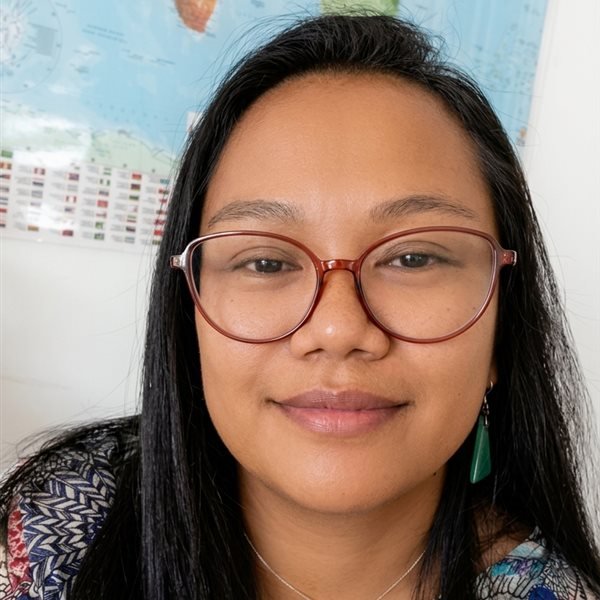
Fanja Rasoanomenjanahary
Fanja has translated between French, English and Malagasy for over 15 years. She was a translator at e2f, a California translation agency, in its Madagascar branch. There, she localized software and marketing content. She then led the translation team at Websu. She uses the Trados and MemoQ computer-assisted translation tools.
White-label work, under confidentiality
Most of our translations were done white-label, under non-disclosure agreements. So we don’t name those clients. We have translated technical manuals and environmental project documents. We have also translated travel and hospitality websites and codes of ethics. For fashion ads, we transcribed the videos in French, then translated the texts into English. France Minéraux’s product pages are also among our translations.
How much does a translation cost?
The price is per word, on a written quote, before any commitment. It depends on two things: the work requested and the type of text.
- The work: fixing an AI translation (MTPE) or a full translation;
- The type of text: a file (document, brochure, manual) or a web page.
A web page costs a little more than a file. The price includes French keyword research, translated tags and publishing on WordPress. Technical or specialized texts (ingredients, regulatory) need more research and cost more. For a video, transcription is billed per minute. Translation follows, per word of the approved text. Every order has a €60 minimum. You know the exact price before you order, and you can pay through Bill.com.
Your questions about translating your store
What is MTPE?
Machine translation post-editing: a human translator takes a machine translation and fixes it until it reads like a text written in French. With us, that means a sentence-by-sentence comparison with the original, research on every term and a double review.
What’s the difference between a review and a translation?
A review corrects a text that’s already translated: meaning, mistakes, tone. A translation starts from the original text. Fixing an AI translation sits in between: we compare each sentence with the original and rewrite it if needed.
Can you fix a translation made with DeepL or ChatGPT?
Yes. It’s actually the most common case. Send us the original text and the translation. We tell you what needs fixing before we quote.
How long does it take?
Count on 2,000 words per working day, double review included. For a technical or specialized text, the timeline is set in the quote.
Do you do certified translations?
No. We translate website and marketing texts, not official documents such as birth certificates.
Do you translate into other languages?
No. We only translate between English, French and Malagasy. These are the languages we know well enough to stand behind our work.
Do you add the translation to my store?
On WordPress and WooCommerce, yes: publishing is included in the price of web pages. On Shopify, PrestaShop and Magento, we deliver the texts ready to paste. Setting up a full multilingual version (plugin, hreflang tags, menus) is quoted separately.
Your store deserves to speak French as well as it speaks English.
Send us a sample: we reply with a quote per word.
The Doc’s references
| Idea | Source | Level | Date checked |
|---|---|---|---|
| Automated translating is among the techniques named under scaled content abuse | Google Search Central, spam policies | 1 | November 16, 2026 |
| Google determines a page’s language from its visible content, recommends one language per page and a different URL per language, with hreflang annotations | Google Search Central, managing multi-regional and multilingual sites | 1 | November 16, 2026 |
| Cosmetic claims are judged in their context, including social, cultural and linguistic factors (recital 6) | Regulation (EU) No 655/2013, EUR-Lex | 1 | November 13, 2026 |
| Only authorized health claims are allowed for food supplements | Regulation (EU) No 432/2012, EUR-Lex | 1 | November 16, 2026 |
| Google doesn’t read “localisation e-commerce” as adapting a store | Google suggestions in France (hl=fr, gl=fr) | Own observation, November 13, 2026 | November 13, 2026 |
| Manda’s and Fanja’s backgrounds: Omniscient Digital, e2f, Websu | Manda Rabemananjara’s LinkedIn profile and the authors’ résumés | Author’s statement | November 13, 2026 |
| France Minéraux named with its consent | Written consent from the co-founder of Newp (email of November 8, 2026) | Author’s statement | November 13, 2026 |
Level 1 means a primary source: an official text or Google’s own documentation. “Own observation” means a test I ran myself, with its date and conditions. An “author’s statement” is information I give about myself and my work. My sources method explains how I choose and rank sources.